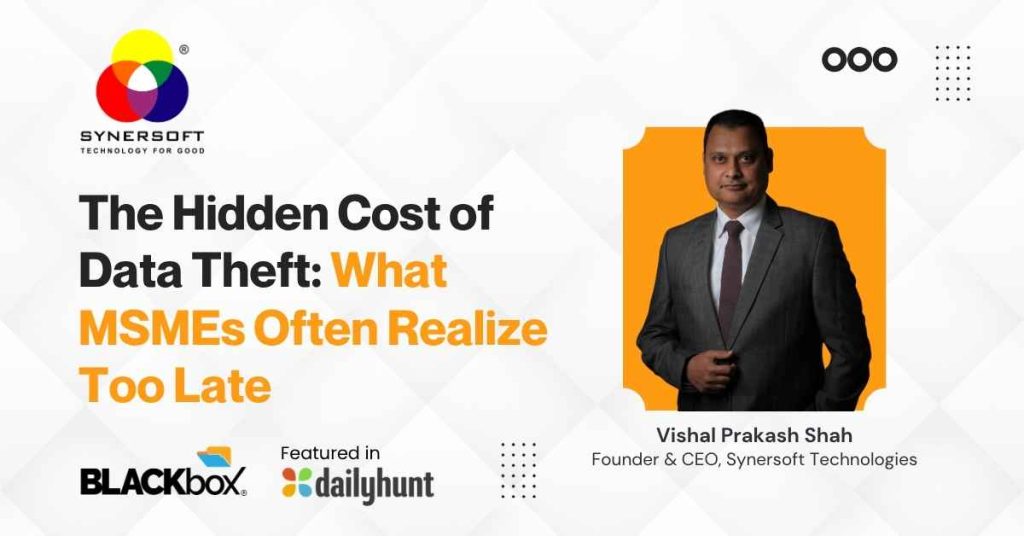
Vishal Prakash Shah, Founder and CEO of Synersoft Technologies
A textile trader in Surat once told me his firm was “fully secure” because he had installed antivirus software on every computer and asked his staff to change passwords every quarter. Eighteen months later, an employee copied his entire buyer list onto a personal USB drive before joining a competitor. No firewall failed. No hacker broke in. The antivirus did exactly what it was bought to do. The business still bled.
Stories like this are why the language around cyber risk in India is changing.
For years, the goal was cybersecurity: stop the attacker at the gate. Increasingly, business owners are talking about cyber resilience instead: assume something will go wrong, and build a business that survives it, recovers from it, and does not depend on any one person’s good judgement to stay safe.
Why MSMEs cannot fight the way large enterprises do
A large enterprise builds resilience through scale: a Security Operations Centre, analysts watching traffic around the clock, layers of monitoring tools stitched together. This is a maximum monitoring, minimum control model. It tolerates fairly liberal internal access, because the assumption is that someone is always watching, and any misuse will be caught quickly.
An MSME with 80 employees cannot replicate this. There is no budget for a SOC, no headcount to triage alerts, and often no one whose full-time job is security at all. If such a company tries to import enterprise-style monitoring anyway, it usually gets a flood of alerts that nobody has time to read, which does not create resilience, it creates blind spots dressed up as dashboards.
The model that actually suits an MSME runs in the opposite direction: maximum controls, minimum monitoring. Rather than watching everyone constantly to catch misuse after it happens, the system is designed on Zero Trust principles so that misuse is structurally difficult to commit in the first place. Nobody gets default access. Data stays centralized instead of scattered across laptops and personal drives. There is simply less activity that needs watching, because there is less that can go wrong to begin with. That is resilience built into the architecture, not resilience bought as a monitoring subscription.
Why bots, not master hackers, are the real everyday risk
Most MSME owners assume their data is not valuable enough to attract a serious hacker’s attention, and they are often right. What they miss is that modern ransomware does not require a motivated human at all. Automated bots crawl the internet nonstop, probing for unpatched software, exposed remote access, and weak passwords, and they treat a small trading company exactly the same way they treat a large corporation. Against this kind of threat, an MSME does not need exotic security tools. It needs the basics done every time: patched systems, locked-down access, and no exceptions made for convenience.
Where the real damage tends to come from
The bigger threat, though, sits inside the four walls of the business, in how ordinary employees use the access they already have. MSME processes are typically built for speed among a small, trusted team, which means information is rarely compartmentalized. A logistics coordinator can often see the same customer contracts as the finance head. A trainee designer can open the same product files as a twenty-year veteran.
That openness shows up in familiar, almost boring ways. A vendor payment file gets shared over WhatsApp because it is faster than setting up a secure transfer. A regional manager accesses the ERP over RDP from a home laptop that has not been patched in a year. A warehouse supervisor plugs in a personal USB drive to move stock data, because nothing on the system stops him from doing so. An accounts executive, in a hurry, deletes a batch of vendor invoices instead of archiving them. An employee under an NDA forwards a partially finished design to a friend “for a second opinion,” not realizing that single email attachment now exposes the company to a contractual liability regardless of intent. Elsewhere, a team installs a pirated version of a design tool to dodge a licensing fee, and the cracked installer quietly plants malware that spreads to every machine on the same network.
None of these people set out to cause a crisis. Each of them simply used the freedom the business process handed them, and the company had no way of knowing the difference between careless and malicious until the damage was already done.
The real fix is not more vigilance, it is less exposure
Telling employees to “be more careful” is not a strategy, it is a hope. Asking an already-stretched MSME owner to also become a full-time monitor of who accessed what, from where, is not realistic. Genuine cyber resilience for an MSME comes from designing the business process itself so that misuse cannot happen quietly in the background, whether the person behind it meant harm or not.
BLACKbox exists for exactly this reason: it is a Security in a Box solution that lets an MSME switch on blanket Zero Trust controls immediately, without ever needing to build or staff an internal IT or security function to make it work.
About the Author:
Vishal Prakash Shah is the Founder and CEO of Synersoft Technologies. A seasoned technology stalwart, an inventor of patented cybersecurity technologies, a writer, a serial entrepreneur, and an investor, he is known as the “Go to Guy” for MSMEs. His expertise in IT security and business resilience has positioned him as a trusted advisor for enterprises navigating the digital age.